Searching for the Rosebud
I’m a café guy. And while I try to avoid snobbery, I do have a type. Sure, I can be captivated by the indie café with the minimalist aesthetic, sleek espresso machine, and geeky gadgets. But the cafes that have my heart feel lived in. They’re the ones where the room itself invites you to stay a while, talk, conspire, collaborate, create.
When I’m in New York City, I always stop at Caffe Reggio in Greenwich Village. I’ll have a latte on the terrace, then wander inside to soak up its bohemian aura—the round marble tabletops, the dark wood banquettes, the chocolate brown plaster walls displaying an eclectic mixture of artwork, clocks, and sculptures. The vintage 1902 espresso machine on the back wall isn’t a museum piece exactly; it was just never asked to leave.
They may not have taken selfies at Caffe Reggio, but generations of poets and musicians like Kerouac, Ginsberg, Brodsky, and Bowie, have had their favorite tables. The room itself carries a rich energy from absorbing decades of human triumph and tragedy, enthusiasm and ennui, depth and desire—elegant in its gentle decay.
Caffe Reggio may no longer be everything it once was, but it survives, and its walls tell a story you can’t hear anywhere else.
On a recent visit to my hometown St. Louis, I felt compelled to search for a similarly legendary café, though I knew I wouldn’t find it. Unlike Caffe Reggio, the Rosebud, along with its entire neighborhood of Mill Creek, has been gone for decades. Since its walls can no longer speak, I wanted to tell the story of this remarkable place that was, for a time, the indisputable hub of ragtime music.
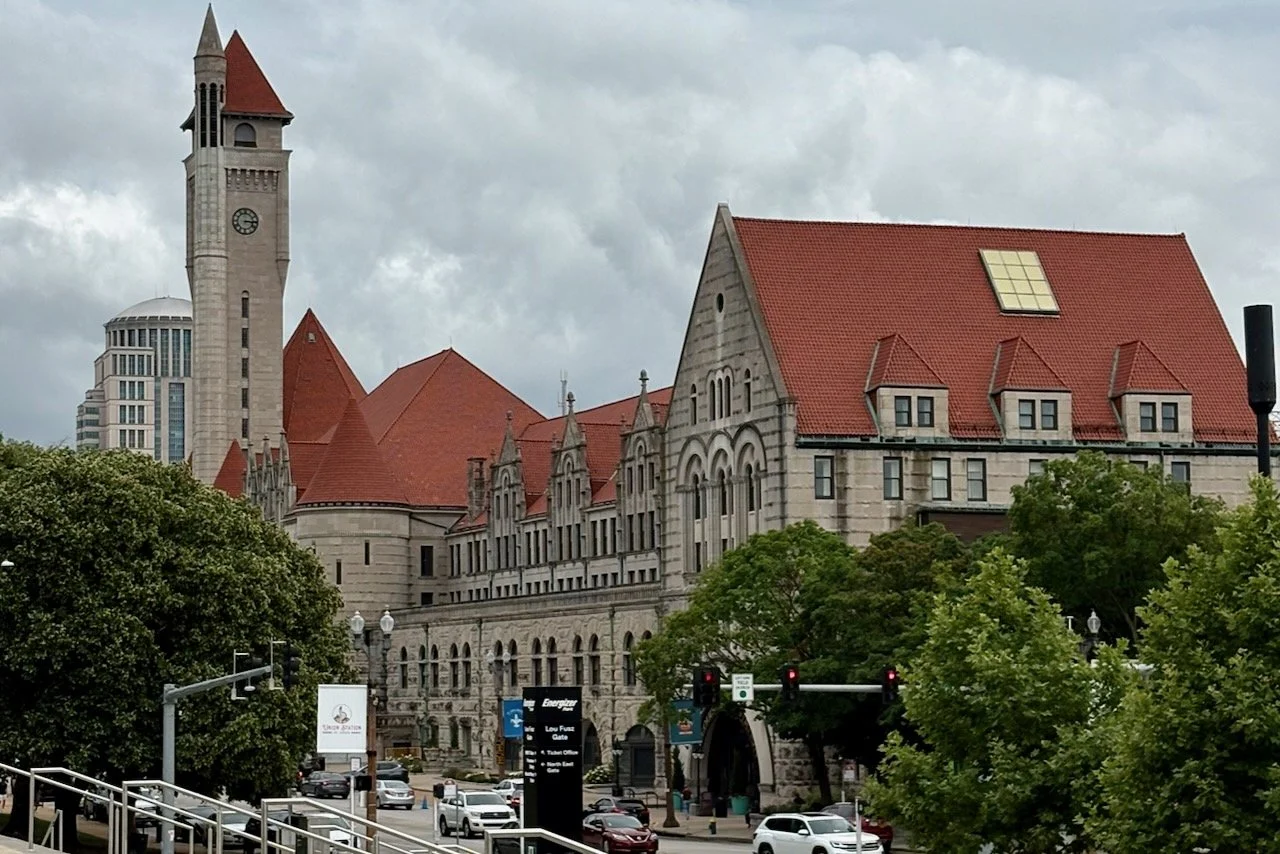
I started my quest in one of the very few neighborhood buildings that survives from the Rosebud’s era, St. Louis Union Station. Now housing an aquarium, St. Louis Union Station was once the largest, busiest railroad station in the world. Descending from its gilded, historic Grand Lobby, I walked west on Market Street— roughly a quarter mile, moderately uphill—to the historic block that once vibed with the sensual, syncopated sounds of ragtime.
The stories people tell about the Rosebud often mix truth and legend. The two most serious and influential accounts focus primarily on the history of ragtime music and its most famous composer, Scott Joplin.[1] Unintentionally, they compress and flatten the Rosebud into static setting and its proprietor, Tom Turpin, into colorful supporting character.
As one who takes cafés a bit seriously, I offer here the most comprehensive primary-source reconstruction of the Rosebud and Tom Turpin yet attempted, restoring their dynamic, living histories. I also hope to address in later essays the curious question of why the Rosebud no longer exists, while so many other historic establishments have survived.
In 1950, authors Rudi Blesh and Harriet Janis published They All Played Ragtime, reviving interest in ragtime music some forty-plus years after the height of its popularity. Their work relied largely on interviews and correspondence with people who were there. In doing so, it documented many irreplaceable memories and perspectives, while effectively capturing the spirit of the time. Unfortunately, decades-old memories are not always as precise as we would like them to be. Over time, fact gives way to myth and myth to legend.
The legend of Tom Turpin and the Rosebud Café is based largely on the snapshot found in They All Played Ragtime, notably chapter 3. It usually goes something like this.
Tom Turpin was a pioneer ragtime composer and piano player. His “Harlem Rag” was the first rag published by a Black composer. Turpin was a rather large man with big hands, a hard-banging piano style, and a genial personality that caused other musicians to flock to him.
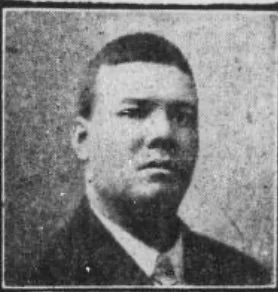
St. Louis Palladium, 1904, newspapers.com.
Around 1900, he opened the Rosebud Café, and it quickly became a gathering place for ragtime musicians from around the region. The Rosebud had two bars in the front, a café with two large dining rooms, a private dining room, a billiards room, and a hunting and fishing club room. In the back was a large wine room with a raised piano in the center. Since Tom’s size required that he stand to play the piano, it was set high on blocks. The second floor of the Rosebud was, depending on who is telling the story, either a gentlemen’s hotel or a brothel. About a block away, he had a small private shack with another piano he called the Hurrah Sporting Club.
The main attraction at the Rosebud was the wine room, and its featured entertainment was the “cutting contest,” where pianists would show off their virtuosity head-to-head until one of them was “cut” and another took his place, finally leaving only one standing. Frequent performers in the room included such notable musicians as Louis Chauvin, Joe Jordan, Sam Patterson, and occasionally, Scott Joplin. Joplin, unmatched as a composer, was overmatched in Turpin’s cutting contests, so he tended to avoid them. At times, the cutting contests took place at “Mother Johnson’s” across the street or in the Hurrah Sporting Club, rather than at the Rosebud.
During the 1904 World’s Fair, with an estimated 20 million visitors to the exposition, the Rosebud flourished. But after the Fair, the crowds returned home, the musicians moved on to Chicago and New York, ragtime gave way to blues and jazz, and the Rosebud faded into history. By 1906, after six short years, it was closed.
But that wasn’t the end for Tom Turpin. He and his brother Charles went on to create an entertainment empire that encompassed theaters, saloons, dance halls, gambling houses, and brothels.
That is the legend of Tom Turpin and the Rosebud Café. Some is fact; some is likely conflation; and there is an element of romanticization—the kind of flattening that occurs when you pull a still from a film. Almost none of it was directly documented by Blesh and Janis, nor was it fully backed—in print, at least—by eyewitness testimony.
I think we can do better.
Perhaps the best way to understand the Rosebud is to see it in the context of Tom Turpin’s full career. Here is where the legend begins to crack. While Tom and his brother Charles established several different venues in their lifetimes, Tom only ever ran one establishment at a time. The same is true for Charles.
This reconstruction is in no way meant to diminish what these two brothers accomplished. If anything, it underscores the tenacity required for them to succeed in a city where, as I plan to show in a future essay, the odds were constantly stacked against them. With that in mind, here are the five establishments that shaped Tom’s life and career.
In 1890, Tom Turpin’s father, “Honest John” Turpin, opened a saloon in a long, narrow brick building at 425 S 12thStreet.[2] It was called simply “Turpin’s Saloon.” One account has Scott Joplin making his way to Turpin’s as soon as the early 1890s.[3]
During that time, John and his family—wife Lulu, Tom, Charles, Eleanora, and Nannie—lived in a three-story brick building, likely renting a room or rooms at 9 Targee Street, adjacent to St. Joseph’s Orphan Asylum. Tom worked at the saloon as a bartender and musician from the ages of 17 to 21, often playing piano to entertain customers.[4]
During its five-year run, Turpin’s saloon was well known to local authorities. In 1891, a 19-year-old man allegedly killed an 81-year-old man there with a billiard cue.[5] The same year, a Turpin’s bartender was arrested for shooting a “crawfish peddler.”[6] The next year, Turpin’s was listed, along with 700 other unlicensed saloons, in a St. Louis Post-Dispatch exposé of city management.[7]
But perhaps the most damaging incident occurred in February 1894, when John Turpin dueled with John Hall over a dice game on the corner of 12th and Poplar. Shots were fired, five on each side, and both men were taken, uninjured, into custody.[8] Possibly related, Turpin’s saloon went out of business shortly after.
Whatever the reason that Turpin’s shut down, John wasn’t out of business for long. By October of the same year, he had opened the Silver Dollar Saloon, a block north of St. Louis Union Station, at 100 N. 19th Street (lower left on the map below).[9] A year later, the Turpin family moved to a two-story brick building at 2142 ½ Walnut Street, where they likely occupied the second floor. The house was on the same block as the notorious Veiled Prophet’s Association building.[10]
There is some uncertainty about who owned the Silver Dollar. The city directory lists Tom as proprietor one year, and John the next.[11] Perhaps John had to lay low for a while after the shooting and arrest. Meanwhile, Tom’s brother Charles went a different route, taking a job as clerk at the Assessor’s office—the beginning of a politics-adjacent career that, fifteen years later, would see him the first Black man elected as a public official in St. Louis.[12]
Like Turpin’s Saloon, the Silver Dollar was in a long, narrow, brick building. It was three stories high, and it had an additional building in the rear—a square frame structure that had nearly double the footprint of the main building.[13]
At least two news articles described this back room as a “wine room.”[14] At the time, when saloons were male-only establishments, a wine room signified a place where women and men could mix freely, and women could be served alcohol. It also carried the suggestive connotation of a place where sex work was solicited and facilitated.[15]
It’s important to note that the term wine room was an external characterization of the Silver Dollar’s rear room. What’s not clear is whether this characterization was rooted in fact or was merely insinuated by the police and mainstream press. Certainly, such places existed at the time in St. Louis, and the Silver Dollar may well have been one of them, but despite the legend and possible insinuation, there is remarkably little primary source evidence of any Turpin establishment being involved in this type of activity.
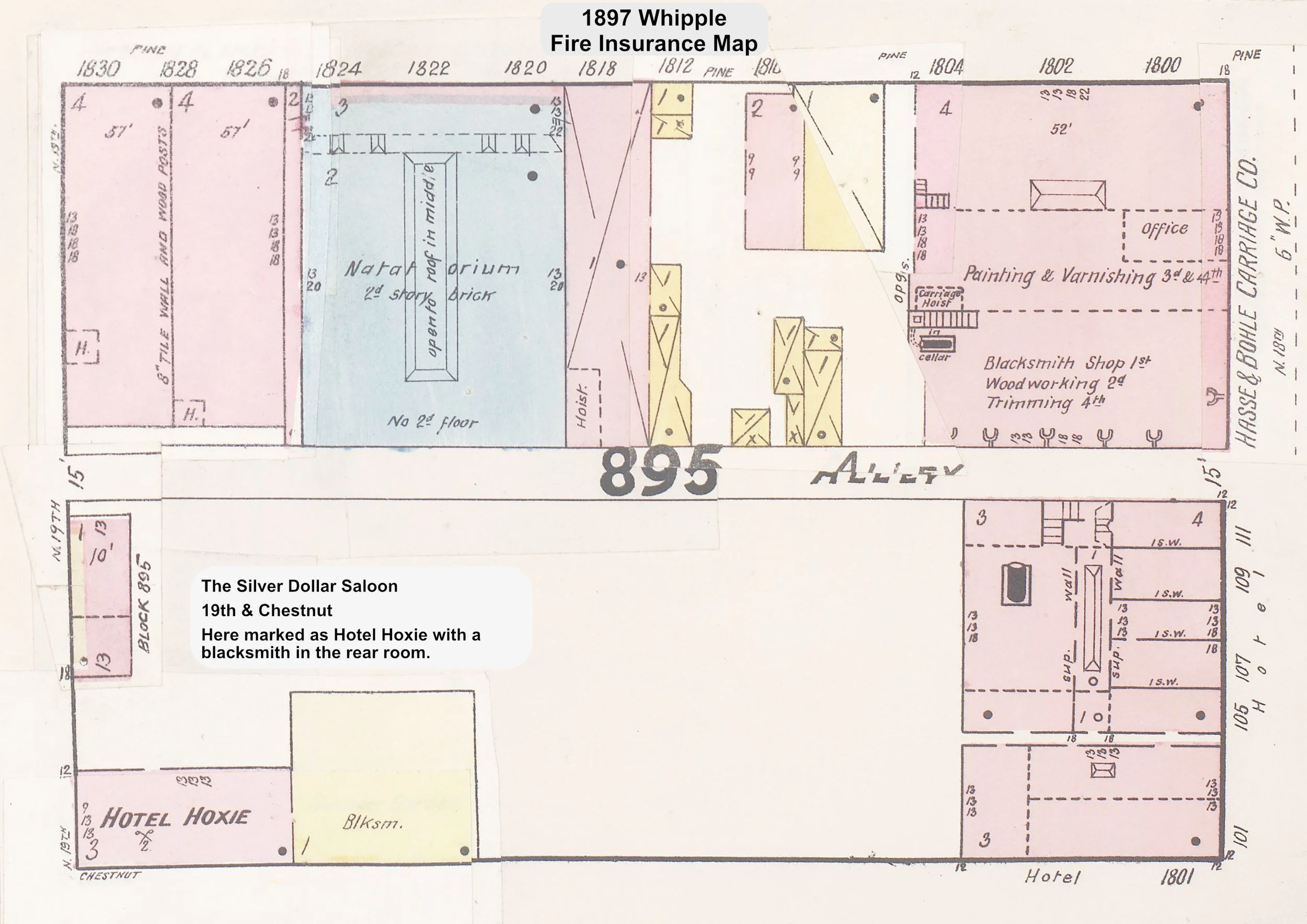
Whipple Fire Insurance Map of St. Louis, MO, 1897, Missouri Historical Society. Labels are my additions.
Though the Silver Dollar Saloon is most often associated with Honest John, it was son Tom who made a name for himself there as a musician. Ragtime histories highlight this period as when pianists were flocking to St. Louis and Tom Turpin began to have a following among them. Since, as we will see, the Rosebud wasn’t open yet, the venue where Tom began gathering, testing, and mentoring ragtime pianists was almost certainly the Silver Dollar Saloon.
Meanwhile, the mainstream newspapers were oblivious to the music history occurring in real time at the Silver Dollar. They mentioned the Turpins only when the police showed up, such as the day when both Tom and John were involved in separate shootings. In one, Tom was shot in the groin; in the other, John was the shooter.[16] It’s not clear from newspaper accounts whether John was ever prosecuted.
After that, though, the Silver Dollar Saloon was raided no less than four times in 18 months. In February 1897, the police raided a dance, arresting 22 women, both Black and white. The St. Louis Post-Dispatch’s sensationalistic coverage claims the women were “indulging in a disgraceful orgie (sic) and dancing ‘Pasamala’ while drunk.[17] Between November 1897 and June 1898, there were three gambling raids upstairs, with dozens of men arrested.[18] In December 1897, a man was stabbed in the “wine room.”[19]
But perhaps the most consequential incident, for our purpose, occurred on February 15, 1898, when Tom shot and killed Abe Keeler in the back room, as he claimed, in self-defense. Tom was arrested, charged, and later released on bond.[20] It’s not clear whether Tom was prosecuted for this shooting. After the incident, however, the Silver Dollar disappears from the historical record.
The next few years were apparently quiet ones for the Turpins. In 1899, the city directory has John as a contractor and Tom as an inspector.[21] In December 1899, a newspaper article, places Tom as a porter in a saloon at Twenty-Third and Chestnut.[22] The 1900 city directory confirms this, and then in 1901 and 1902, it lists Tom’s occupation as “music.”[23]
While the legend says the Rosebud was in operation during this time, the historical record doesn’t support this. Instead, it seems that, during that time, another café or bar occupied the space that would soon become the Rosebud.[24]
In 1902, Tom organized a Black society ball that would become an annual event and feature cutting contests as entertainment.[25] During this time, Tom was also busy managing a Black theater troupe.[26]
That same year, Tom’s father, John Turpin, died after a brief illness.[27] Given the bad press he got during his lifetime, it seems appropriate to share this notice about his death in the St. Louis Globe-Democrat.
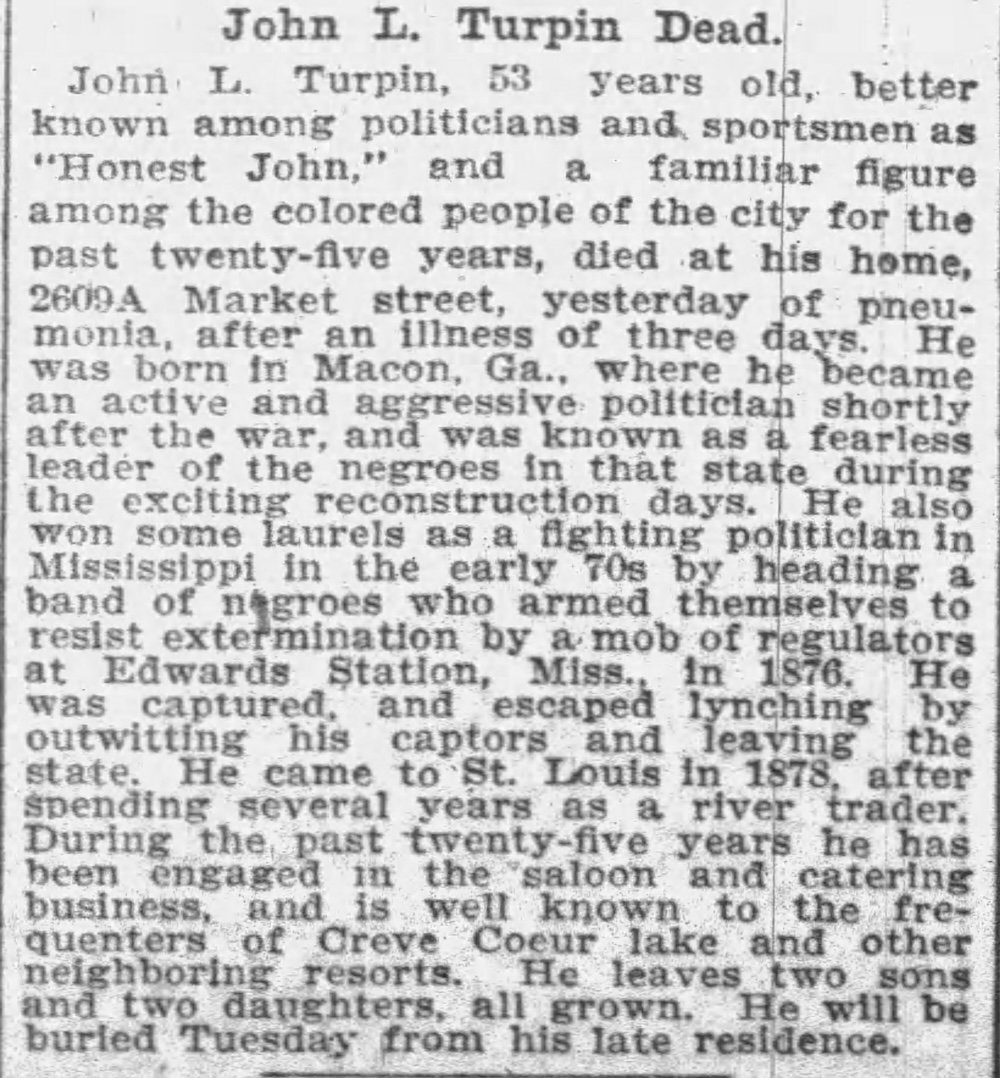
St. Louis Palladium, 1902, newspapers.com.
By the time Tom Turpin opened the Rosebud, in 1903, everyone agrees that he was already a published composer and top-notch performer of ragtime music. He was surrounded by a cadre of young musicians, now in their 20s—men like Louis Chauvin, Joe Jordan, and Sam Patterson. After some years in Chicago and Sedalia, Scott Joplin had moved backed to St. Louis in 1901 and made Tom’s acquaintance. Tom himself was living with his new wife Willie and brother Charles on the first floor of a two-story brick building at 2609A Market Street.[28]
As 1903 began, the Louisiana Purchase Exposition, also known as the 1904 World’s Fair, was just around the corner, and Tom was in the process of publishing his “St. Louis Rag” in anticipation of it. But he was also seizing a bigger opportunity to cash in on the excitement surrounding the Fair.
Roughly 16 months before the opening of the Louisiana Purchase Exposition, the 1904 World’s Fair, Turpin posted his first ad for the Rosebud Bar in a local Black newspaper.[29]
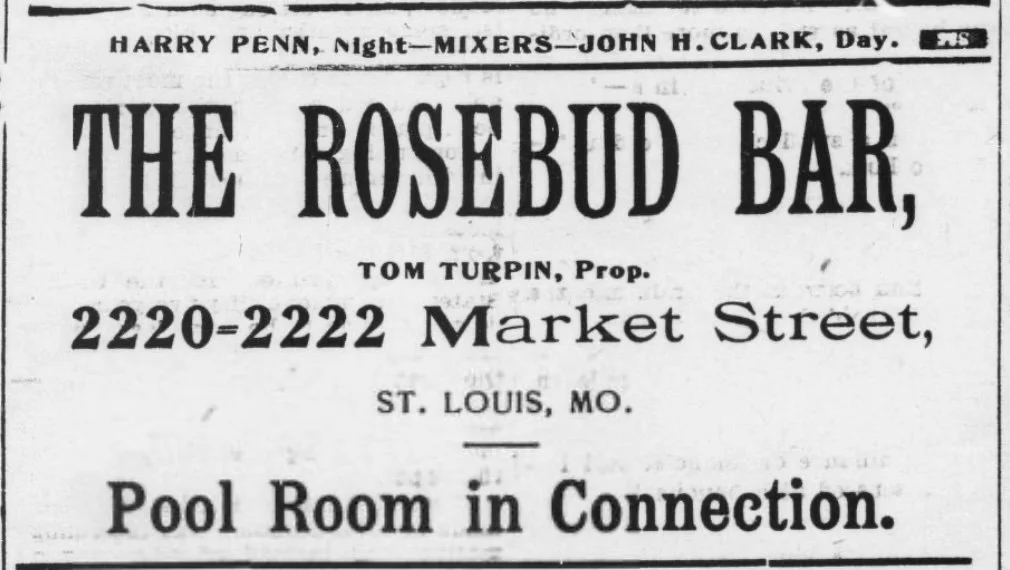
St. Louis Palladium, 1903, newspapers.com.
The same ad would appear, in evolving form, every week until March 1905, a run of just over two years.
The Rosebud Bar sat at the southeast corner of Market and 23rd Street. As the address indicates, it was a combined building with a double storefront. The two-story brick building was, by my estimate, approximately 44 feet wide and 60 feet deep, for a total of 2,640 square feet per floor. The stairway was in the front, between the two connected buildings. Stretching across the back was a frame piazza or porch. Beyond the piazza were some open, frame sheds and, at the back of the lot, an additional two-story brick structure, originally a stable, that measured about 44 feet wide and 34 feet deep, for an additional 1,490 square feet of space.[30]
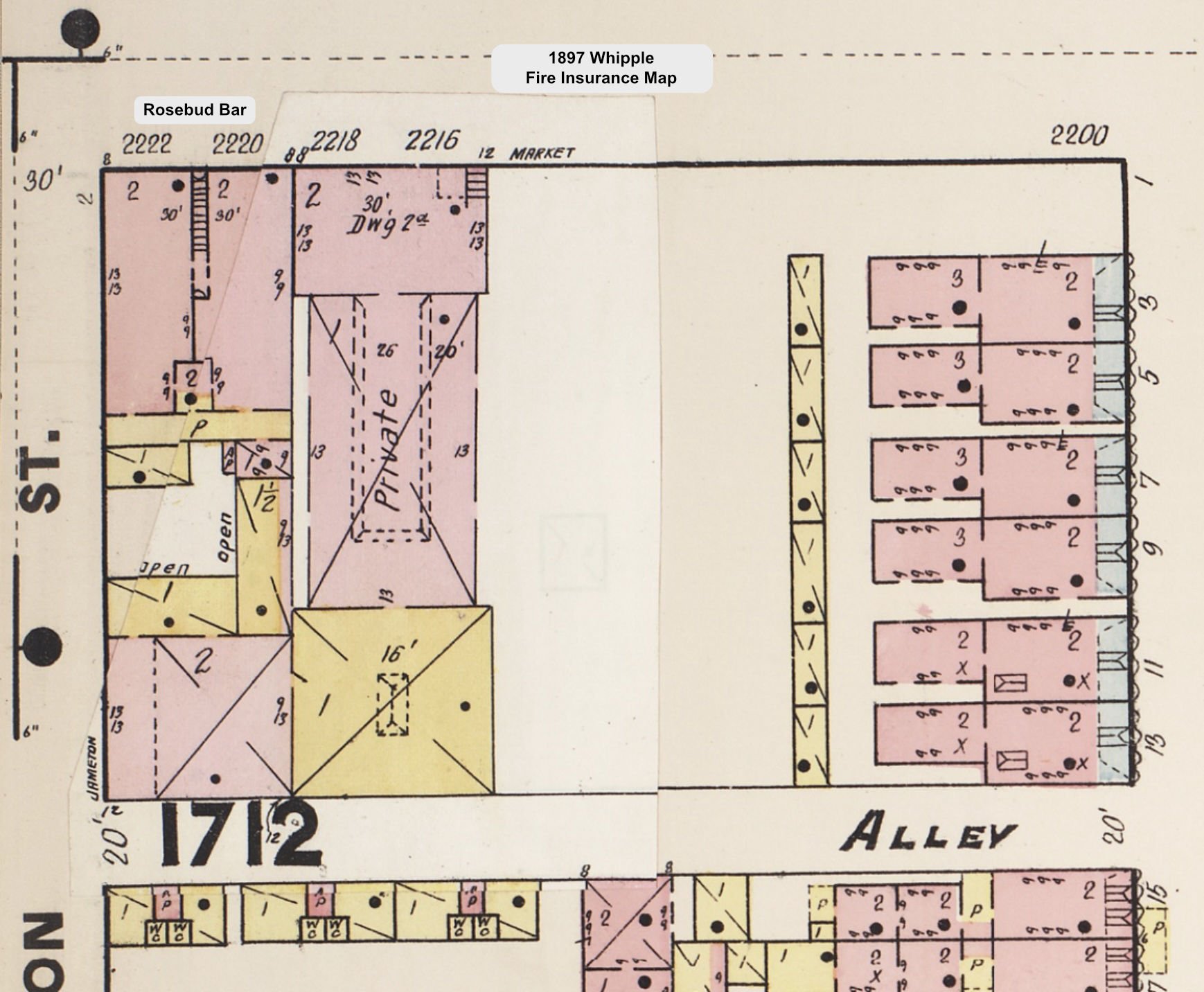
Whipple Fire Insurance Map of St. Louis, MO., 1897, Missouri Historical Society. Labels are my additions.
Legend says that the Rosebud had a double bar up front, one in each storefront. And that seems entirely plausible. Based on the ads, we know the Rosebud always had a pool room, and it would have easily fit in one of the two spaces in the rear. Legend also talks about a hunting and sports club room, and that could have easily fit on the other side in the rear.
What we can see from the map, though, was that there was no large wine room in the rear. This is surprising, since it’s one of the most memorable parts of the legend. I briefly considered whether the wine room might have been in the large brick building on the back of the lot. But this seems unlikely. People said it was in the Rosebud, not a separate building. Given what we now know about the Silver Dollar, it seems more likely that, decades later, people “remembered” things happening at the Rosebud that actually happened at the Silver Dollar. Given how the Rosebud was romanticized after the Fair, it’s easy to see how this might have happened.
If not in the Rosebud, where did the cutting contests take place? Perhaps at Mother Johnson’s across the street or at the Hurrah Sporting Club, both of which hosted them at times, according to Blesh and Janis. I don’t want to completely discount their taking place at the Rosebud, but the available evidence leaves me with serious doubts.
What’s more, just months after the Rosebud opened, Tom struck a deal with two chefs from Texas, allowing them to open a new restaurant in that rear building, likely believing it would draw more Fair business to his bar.[31]
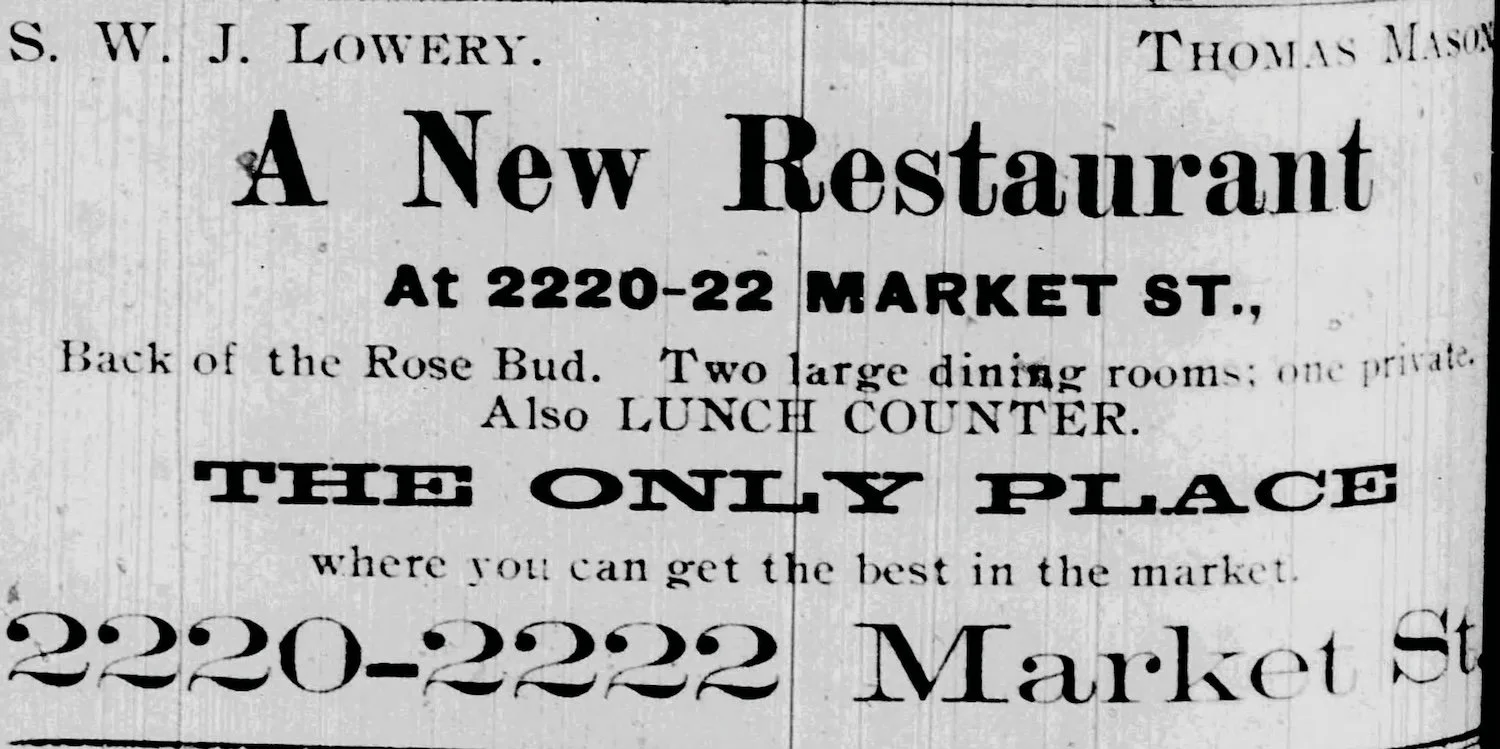
St. Louis Palladium, 1903, newspapers.com.
They later advertised their restaurant as “The Rosebud Café—and Private Buffet.”[32]
So, the Rosebud Café operated on the same property as—and borrowed its name from—Tom Turpin’s Rosebud Bar, assuring that future generations of ragtime enthusiasts would always confuse Tom’s Rosebud Bar with Lowery & Mason’s Rosebud Café.
Around the same time, Tom updated his weekly ad. It includes the best contemporary image we have of the exterior of the Rosebud, with Tom standing in front of it.[33]
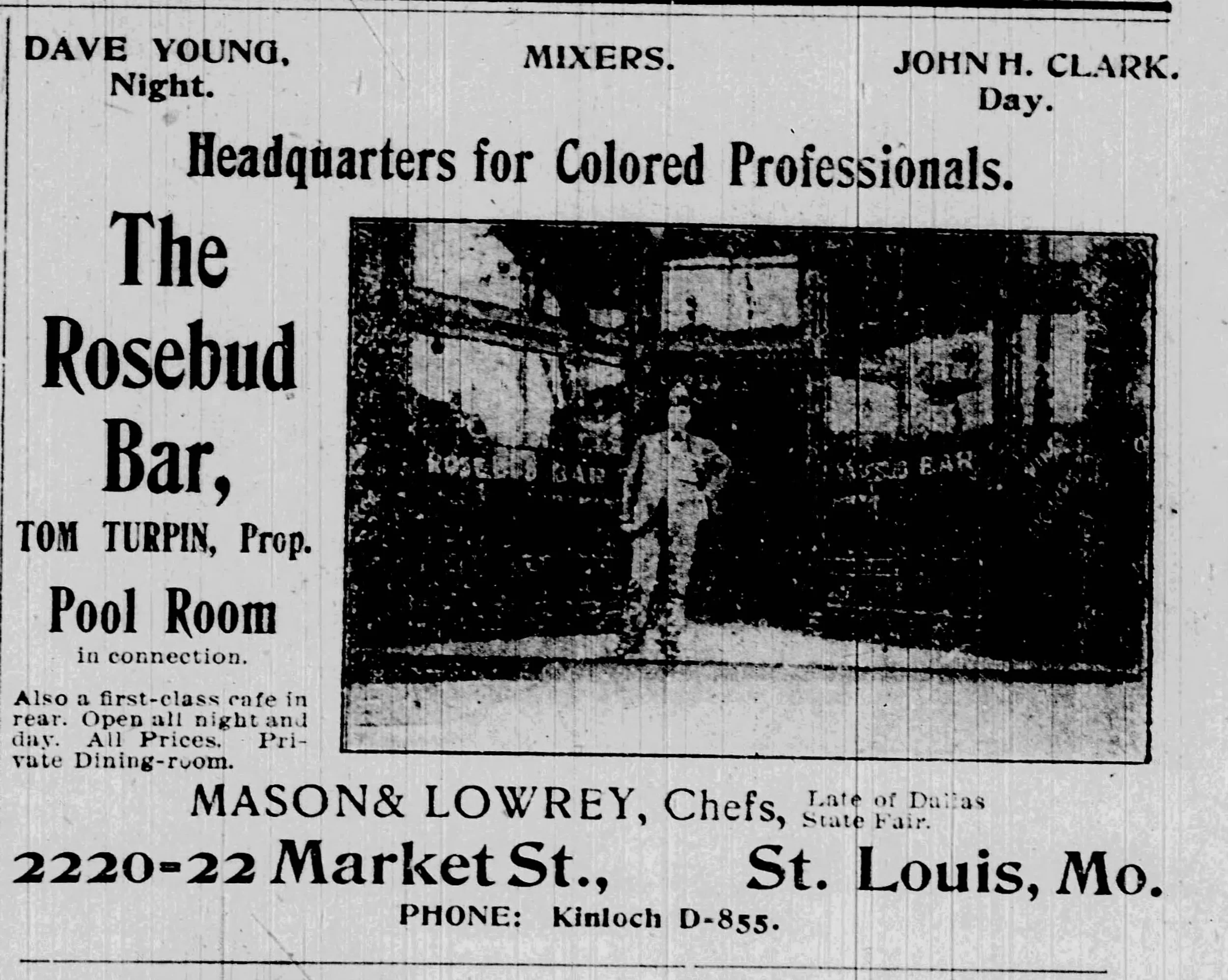
St. Louis Palladium, 1903, newspapers.com.
I can only imagine Turpin’s surprise when, in January 1904, Lowery and Mason announced they were moving their restaurant to a hotel a block over. Before the had even Fair opened, the Rosebud Café had already closed and reopened at a different address as the Newport Café.[34]
After Lowery and Mason’s exit, and throughout the Fair, Tom continued to advertise a “first-class café in rear,” though his ads never again mentioned the name of another café or proprietor. Around the same time, he began touting his saloon as a distributor of “Applegate’s Old Rosebud Whiskey.”[35] From August 1904 until January 1905, someone calling himself “Alabama Tom” advertised “The Alabama Restaurant” in that building.[36] Whether this was our Tom or another is difficult to determine.
Despite the turnover in the rear building, the Rosebud Bar apparently made out very well during the Fair. Once it was over, Tom shared the good fortune by hosting a Christmas party with an “electric Christmas tree” and gifts for everyone in attendance, including at least one bottle of Old Rosebud whiskey.[37]
In March 1905, for the first and only time, the Rosebud Bar drew the attention of the law, when ten men were arrested for gambling in the basement. The paper reports that, when the detective entered the bar upstairs, a lookout tried to ring a buzzer to alert the players. The detective intervened and yanked out the buzzer.[38]
Perhaps the Rosebud had operated a gambling operation throughout its brief existence. Or maybe Tom pivoted to his father’s old tricks to make up for the lack of Fair income. We simply don’t know. Just three weeks after the raid, an ad ran in the St. Louis Palladium announcing that the Rosebud Café had changed hands to a Mr. Robert P. Watson.[39] It’s not clear whether this ad refers to the Rosebud Bar, the café in the rear building, or both. We do know that the Rosebud Bar never ran another advertisement, and 1905 was the last time it appeared in the city directory.
Today, the walls of the Rosebud, like the vibrant community it once served, are no more. Standing there, as I did that day, it’s hard to imagine it was ever there. In its place is a plush green lawn, an iron fence with secured gates, and a distant, cold, unwelcoming federal building that takes up the entire historic block. The room that welcomed so many Black professionals in an unwelcoming city did not survive to tell its own story.
The Rosebud’s closing was followed by another quiet period in Tom’s career.
The historical record from 1906 to 1910 during this time is rather impressionistic. In early 1906, Tom’s brother Charles ran an ad: “For Rent—Three (3) pool tables in good condition. Reasonable rates to right party. Call or address C.H. Turpin, 2633 Market street.”[40]
Around the same time, a local gossip columnist wrote, “We believe we saw the form of Mr. Tom Turpin. He is looking well.”[41]
Some have suggested Tom went out west for a while to check on a gold mine claim in Nevada, and indeed, he is not listed as a resident in the city directory from 1906-1909. When Turpin reappears in the St. Louis directory in 1910, his occupation is listed as cook, while the 1910 U.S. Census lists him as a musician.[42]
Edward A. Berlin, in his book, King of Ragtime: Scott Joplin and His Era, asserts that Tom opened Eureka Club at 2208 Chestnut at this time, but the historical record on this remains sketchy at best.[43] From 1910–1912, that address is known to the press as the headquarters of the Missouri Eureka Republican League Club, a political organization for Black citizens, of which Tom and Charles were active members.[44] There are scattered out-of-town references to Tom and Charles entertaining guests at the “Eureka Club.”[45] However, there is no record in the city directory or local press of Tom owning a club during this time. It seems likely that the “Eureka Club” was a private political club that kept a bar and possibly a buffet for members.[46]
Speaking of politics, in 1911, Tom’s brother Charles became the first Black man elected to office in St. Louis, when he was elected Constable in the Fourth District. He held that office, despite some election shenanigans from the other side, for most of 12 years.[47]
Alongside their political involvement, the brothers geared up their efforts in the entertainment business. In 1910, Tom applied for and was received into the Colored Vaudeville Benevolent Association (CVBA).[48]
In the summer of 1911, brother Charles opened an outdoor venue in a tent on an open lot at the southeast corner of Market and 23rd, a half-block west of the former Rosebud. The Booker T. Washington Airdome, as it was known, featured Vaudeville-style entertainment. In the annex next door, Charles experimented with making and screening motion pictures. Tom was manager of the theater, and given his connections within the entertainment world, he was likely involved in lining up talent, among other things.[49]
In March 1913, Charles announced that he was going to build a permanent theater on the lot where the Airdome had been operating. It would be called the Booker T. Washington Theater.[50] “The Booker” was one of the first Black-owned theaters, and for more than a decade, it presented the best in Vaudeville entertainment, while screening numerous motion pictures.
Perhaps spurred on by his brother’s success, Tom got back into the saloon business in the same year, opening a bar in a narrow two-story brick building at 2333 Market, not quite a block from the Booker. For the first time, it seems, Tom and his wife lived in the same building where he worked, on the second floor above his saloon.[51]
Of all the establishments Tom Turpin was involved with, we know the least about this unnamed saloon. That’s because it seems to have experienced no trouble with the law, and Tom apparently didn’t run any ads for it in the local media.
In early 1915, Vaudeville performers Dude Kelly and Amon Davis, after finishing up a run at the Booker, purchased a half interest in Tom’s saloon.[52] That week, Dude Kelly made a splash serving as a bartender there.[53] A few months later, an item in the Indianapolis Freeman, a Black newspaper with national reach, noted that Tom had “his old usual smile.”[54] Later that year, a news item incidentally referred to “Turpin’s Buffet.”[55] That’s about all we know.
In December 1918, Charles named Tom Deputy Constable.[56] Read into that what you will. And in 1919, not long after the 18th Amendment was ratified, Tom’s longest running—and quietest—saloon closed its doors.[57]
Tom Turpin, however, was ahead of the game. With the ragtime era fading, and Prohibition looming, Tom opened his third and final establishment, the alcohol-free Jazzland Dance Palace. In keeping with the times, Jazzland featured “clean and wholesome” entertainment and “no intoxicating liquors.” Tom assembled a jazz orchestra featuring piano, strings, brass, woodwinds, and percussion.[58]
The building itself, next door to the former Rosebud at 2216-2218 Market Street, was a combined, two-story brick building. The two-story section was 25-30 feet deep. Behind that a door led to an approximately 40 feet x 75 feet, 1½ story building, which likely served as the dance hall. Immediately behind that was a frame building, filling out the entire double lot.[59] In 1920, the frame building was torn down to make way for a Jazzland Garden, billed as “an oriental dream of exquisite beauty,” including an electric fountain, pagodas, trellises, moon vines, specially designed electrical and lighting effects, and more, allowing guests to enjoy a pleasant nighttime setting until closing time at 3 a.m. [60]
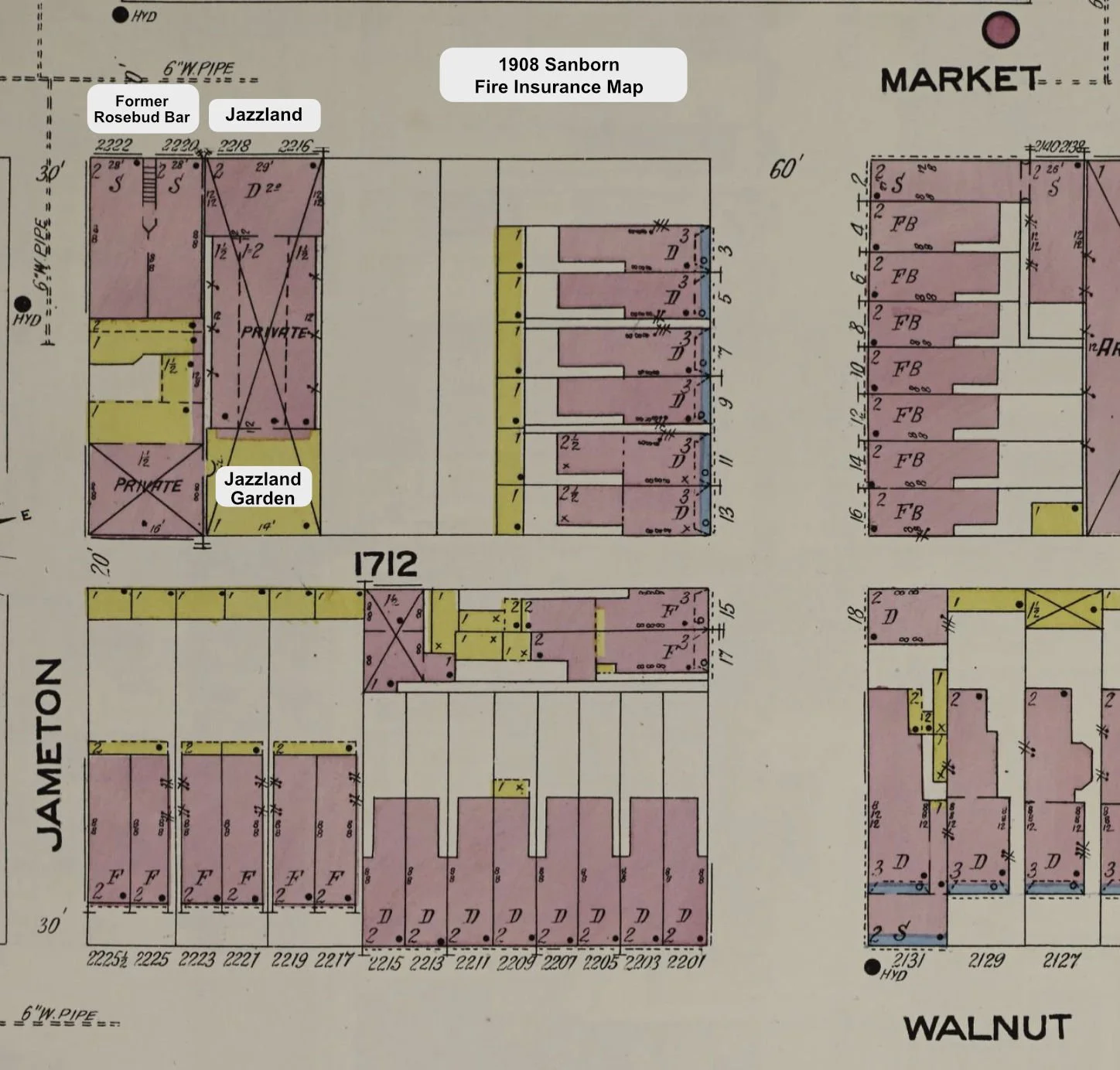
Sanborn Fire Insurance Map for St. Louis, 1908, Missouri Historical Society. Labels are my additions.
Opening night was a huge success, although the building was “too small for the immense crowd.” Throughout the night, a large group waited outside, hoping to get in. In addition to the dance floor, the Jazzland featured soft drinks, a candy and tobacco store, and a menu featuring “all the delicacies of a first-class café.” Tom’s new venue reportedly employed fifty men and women, including Tom’s wife, Willamette “Willie” Turpin, who served as chef/caterer.[61]
If there was ever a time that Tom and Charles could be said to have an “entertainment empire,” it was this period—from summer 1919 to summer 1922. The Booker T. Washington Theater and Jazzland Dance Palace, on adjacent blocks, were the leading entertainment venues in the district. Jazzland itself featured a constantly evolving entertainment slate, including dance contests, dance instruction, professional entertainment, and a lot more, that kept patrons returning night after night. This period, more than any other, is where Tom came into his own as a promoter and businessman. [62]
One of the more interesting events that Tom hosted at Jazzland was an alternative “Veiled Prophet Ball,” in response to the original organization formed by the city’s elite in 1878. The ball featured its own Veiled Prophet, a crowned queen, and six maids of honor.[63]
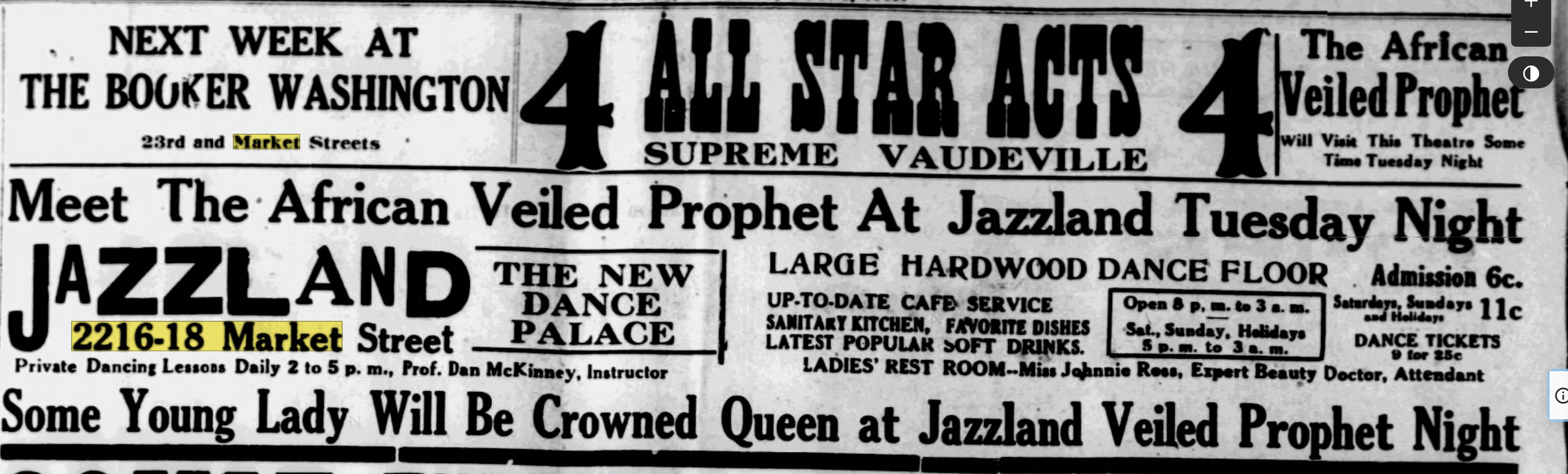
St. Louis Palladium, 1920, newspapers.com.
Unfortunately, Tom’s success was cut short by his own health. Jazzland had only been open a year when Tom fell ill from “stomach ailments.” It was said that his weight dropped from 315 to 147. While family and friends believed him to be rebounding, on August 18, 1922, he passed in his residence above Jazzland at 2216 Market Street.[64]
Crossing Market Street and turning back toward Union Station, I stopped at the Pillars of the Valley monument on the grounds of Energizer Park, current home of St. Louis City SC. The monument memorializes Chestnut Valley—the entertainment district where Tom lived and worked—and the larger Mill Creek neighborhood of which it was a subset. It is a powerful, but insufficient reminder of an entire historic Black neighborhood—St. Louis’s own Harlem—that was erased in the name of urban renewal.
The Rosebud is but one small example of what was lost. To understand why it didn’t survive is to understand the social and political conditions that initially made it possible and ultimately led to its demise. I intend to explore that territory in a future essay.
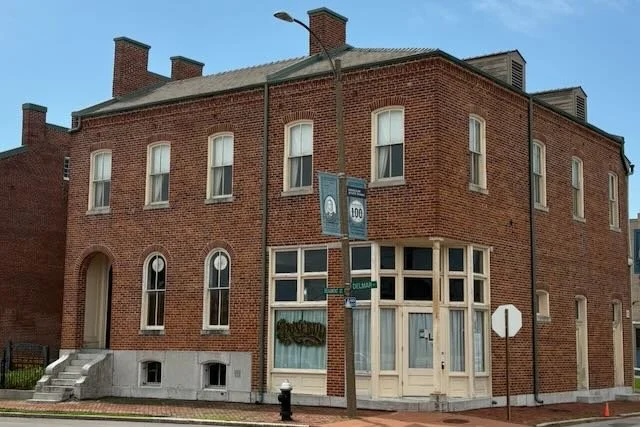
Before I left St. Louis, I paid a visit to the Scott Joplin House State Historic Site. This is a building on Delmar (formerly Morgan), ten to twelve blocks north of Market (depending on what counts as a block). For a short time, Scott Joplin rented a room there. A few years ago, they opened the “Rosebud Café” next door, as an annex to the Joplin Museum.
The information I had found online was that a tour of the Joplin House included a tour of this Rosebud replica. So I took the Joplin House tour, on which I was the only guest, and anticipated seeing the reimagined Rosebud at the end. The tour ended with no mention of the Rosebud, so I asked the tour guide if I might peek into it. She indicated that wasn’t something that could happen.
On the way out, I found a person who seemed to be in charge and asked if there was any way I could take a look at the Rosebud.
She said, “It’s not a working café. You can’t order anything.”
“I know. I was just hoping to poke my head in.”
“It’s not the real Rosebud. It’s just a re-creation using this building’s footprint.”
“I know. I was still hoping to see it.”
“They have an event in there once a month. Maybe you could look at the schedule and come back for that.”
“I would, but I’m from out of town. I’m a writer, and I came here specifically for the Rosebud.”
“Sometimes they post videos online. Maybe you could find one of those and get a feel for it.”
I realized she was just doing her job, so I politely thanked her for her time.
On the way to my car, I passed the Delmar Rosebud’s storefront windows.
The curtains were drawn.
Tom Turpin’s Published Music
1897 - Harlem Rag (written in 1892)
1899 - Bowery Buck – Ragtime Two Step
1900 - A Ragtime Nightmare
1903 - St. Louis Rag
1904 - Buffalo Rag
1914 - Pan-Am Rag[65]
1917 - When Sambo Goes to France[66]
Source Abbreviations
The following source abbreviations are used in the notes; full access information appears here and is not repeated in the notes.
GDSL – Gould’s Directory for St. Louis (accessed at cdm16795.contentdm.oclc.org/digital/collection/p16795coll7)
IF – Indianapolis Freeman (accessed at loc.gov/item/sn82016211/)
KCS – Kansas City Sun (accessed at loc.gov/item/sn90061556/)
NYA – New York Age (accessed at loc.gov/item/sn83030005/)
SFIM – Sanborn Fire Insurance Map for St. Louis
1908, Vol. 1 (accessed at loc.gov/item/sanborn04858_004/)
1909, Vol 2. (accessed at loc.gov/item/sanborn04858_005/)
SLA – St. Louis Argus (accessed at newspapers.com)
SLAm - St. Louis American (accessed at newspapers.com)
SLGD – St. Louis Globe-Democrat (accessed at newspapers.com)
SLP – St. Louis Palladium (accessed at newspapers.com)
SLPD – St. Louis Post-Dispatch (accessed at newspapers.com)
SLR – St. Louis Republic (accessed at newspapers.com)
SLST – St. Louis Star and Times (accessed at newspapers.com)
WFIM – Whipple’s Fire Insurance Map of St. Louis, MO.
1892, Vol. 1 (accessed at data.library.wustl.edu/record/108232 and mohistory.org/collections/item/Lib235-00001)
1897, Vol. 1 (accessed at data.library.wustl.edu/record/108241 and mohistory.org/collections/item/Lib238-00001)
1897, Vol. 2 (accessed at data.library.wustl.edu/record/108242 and mohistory.org/collections/item/Lib238-00002)
Notes
1. See Rudi Blesh and Harriet Janis, They All Played Ragtime (New York: Grove Press, 1950), widely considered the Bible of ragtime. While it played an important role in bringing ragtime back to the public’s attention, its method of relying heavily on oral history has left it open to criticism on matters of historical accuracy.
See also Edward A. Berlin, King of Ragtime: Scott Joplin and His Era (New York: Oxford, 1994). Berlin’s work is more archival and scholarly, and it made a significant contribution to our understanding of its subject. In its focus on Joplin, however, it adds little depth to the accepted, flattened image of the Rosebud and Tom Turpin.
2. See GDSL, 1890, p. 1678, for the first appearance of Turpin’s saloon. It also appears in 1891, p. 1757; 1892, p. 1948; 1893, p. 1821; and 1894, p. 1899. The saloon disappears from the directory after 1894, suggesting that it closed that year.
3. See Blesh and Janis, p. 75.
4. See GDSL, 1890, p. 1325, for Tom’s first appearance. See also 1891, p. 1394; 1892, p. 1550; 1893, p. 1420; and 1894, p. 1485.
For the housing detail at 9 Targee Street, see WFIM, 1892, vol. 1, p. 52.
Incidentally, Targee Street was where the events that inspired the folk song, “Frankie and Johnnie,” took place. See “They Were Giants in Those Early Ragtime Years in St. Louis,” SLAm, Feb. 20, 1964, and “Ballad of Frankie and Johnny,” https://www.stlblackheritage.com/stlbhn-trail-locations/frankie-and-johnny, accessed July 13, 2026.
5. See “Killed with a Billiard Cue,” SLGD, Mar. 28, 1891, p. 6.
6. See “Bartender Owens and the Negro ‘Brocky’ Held for Murder,” SLGD, May 30, 1891, p. 11.
7. See “Look at This! Over Seven Hundred Unlicensed Saloons Found in St. Louis,” SLPD, Feb. 10, 1892, p. 6.
8. See “Bullets Rained: Two Negroes Indulge in a Duel on the Street,” SLPD, Feb. 13, 1894, p. 2.
9. See “Ran Against a Detective,” SLPD, Oct. 30, 1894, p.5, and “Had Chloroform and a Skeleton Key,” SLGD, Oct. 30, 1894, p. 5.
10. See GDSL, 1896, p. 1626. For housing detail, see WFIM, 1897, vol. 1, p. 56).
11. Despite the saloon appearing in the news in 1894, it didn’t appear in the city directory until 1897, where Tom is listed as proprietor and John manager. See GDSL, 1897, p. 1707-1708, 2180. Similarly, in the 1895 directory, though the Silver Dollar doesn’t yet appear, Tom’s occupation is listed as “Restaurant” and John’s as “Manager” (p. 1497).
12. See GDSL, 1895, p. 1497, and “Negro Constable Tells Plans,” SLST, Nov. 10, 1910, p. 4.
13. See WFIM, 1897, vol. 2. p. 70.
14. See “Stabbed and Locked Up: Dispensary Patient Proves to Be Under Indictment,” SLPD, Dec. 7, 1897, p. 10, for example.
15. See Richard F. Selcer, “Wine, Women and . . . What’s Wrong With That?” https://historynet.com/wine-women-andwhats-wrong/, accessed July 13, 2026.
16. For various accounts, see “Tom Turpin Shot: A Negro Claims He Was Wounded Without Provocation,” SLPD, Nov. 1, 1896, p. 6, “Two Shooting Affrays: Tom Turpin Shot in One and His Father the Shooter in the Other,” SLGD, Nov. 1, 1896, p. 16, and “Jack Turpin Wanted a Row: Shot a White Man and Begged for Mercy, Saying It Was an Accident,” SLPD, Nov. 1, 1896, p. 6.
17. See “Minor Criminal Matters,” SLGD, Feb. 16, 1897, p. 9, and “Dancers Arrested: Twenty-Two Women Locked Up for Having Too Much Fun,” SLPD, Feb. 16, 1897, p. 10.
18. See “Craps Players Resisted: Police Have a Lively Time with Negro Gamblers,” SLPD, Jan. 21, 1898, p. 6, “Raid on Negro Gamblers,” SLPD, Oct. 10, 1897, p. 30, and “Minor Criminal Matters,” SLGD, June 6, 1898, p. 11.
19. See “Stabbed and Locked Up: Dispensary Patient Proves to Be Under Indictment,” SLPD, Dec. 7, 1897, p. 10. See also the slightly humorous incident involving the police being called to the saloon because of a report of a “dead man lying on the floor,” only to be informed that the man was drunk and had been lying there an hour. The article concludes: “Investigation proved that the latter statement was correct. See “Was Only a Drunk,” SLPD, Dec 14, 1897, p. 8.
20. See “A Duel to the Death: Desperate Fight With Revolvers at Short Range,” SLPD, Feb. 15, 1898, p. 10, “Fought to the Death: Abe Keeler, Colored, Shot and Killed by Thomas Turpin,” SLGD, Feb. 16, 1898, p. 11, “The Turpins Held,” SLGD, Feb. 18, 1898, p. 9, and “Released on Bond: Thomas Turpin Charged with the Killing of Abe Keeler,” SLGD, Feb. 20, 1898, p. 12. This one incident accounts for two of the three instances where the newspapers reference a “wine room” at the Silver Dollar.
21. See GDSL, 1899, p. 1758.
22. See “Defaulter Drowned,” SLGD, Dec. 24, 1899, p. 16.
23. See GDSL, 1900, p. 1852; 1901, p. 1947; and 1902, p. 2051.
24. For example, in 1902, posted several “For Sale” ads for restaurant items at the future Rosebud’s address, including an “8-hole Majestic range; used only 6 months”; “Lumo gaslights, 5; good order; also chairs, linoleum, glasses, bar goods, etc. cheap”; “cash register; National; good condition; cheap”; and “Pool table; combination for pool and billiards.” Far from being signs of a thriving Rosebud Café, these ads suggest that the Rosebud was preceded in 1901-1902 by a café that closed up shop after just a few months. See “For Sale,” SLGD, Jan. 21, 1902, p. 9, and Jul. 3, 1902, p. 10.
25. We know this from the fact that the “Third Annual Rosebud Ball” took place in 1904. The 1904 ball included a cutting contest that featured Tom Turpin and Louis Chauvin, with Chauvin being declared the winner. See “The Rose Bud Ball,” SLP, Feb 27, 1904, p. 1.
26. See “Wait for the Dandy Coon Co.,” SLP, Mar 21, 1903, p. 1.
27. See “John L. Turpin Dead,” SLGD, Apr. 28, 1902, p. 5. As a Pattonville High graduate, I find the Creve Coeur Lake reference fascinating.
28. See WFIM, 1897, vol. 2, p. 71.
29. See SLP, Jan. 10, 1903, p. 5. Note that Tom didn’t mention—and never would—a wine bar at the Rosebud Bar, such as was suggested at the Silver Dollar Saloon. If the Rosebud did feature a wine room—for which, again, there is no evidence—it likely only stayed a few months until the rear building was put to a different use.
30. See WFIM, 1897, vol. 1, p. 56 and the SFIM, 1908, Vol. 1, p. 8.
31. See SLP, Oct. 17, 1903, p. 8.
32. See SLP, Jan. 16, 1904, p. 8.
33. See SLP, Oct. 17, 1903, p. 8.
34. See SLP, Jan. 9, 1904, 5, and Mar. 26, 1904, p. 5.
35. See SLP, Sep. 17, 1904, p. 4.
36. See SLP, Aug. 27, 1904, p. 8.
37. See “Mr. Tom Turpin: A Rosebud Novelty,” SLP, Dec. 24, 1904, p. 1.
38. See “Subdue ‘Look-out,’ Capture Players: Detectives Raid Negro Craps Game in Basement at 2220 Market Street,” SLPD, Mar. 18, 1905, p. 1, “Gamblers Work in Daytime Since Lid Has Been On, SLGD, Mar. 19, 1905, p. 57, and “Lookout Tries to Warn Them: Ten Negroes Arested (sic) in Saloon Charged with Craps Shooting,” SLR, Mar. 19, 1905, p. 22.
39. See SLP, Apr. 8, 1905, p. 5.
40. See SLP, March 3, 1906, p. 5.
41. See “Rip Saw Column,” SLP, Apr. 14, 1906, p. 5.
42. See GDSL, 1910, p. 2052.
43. See Berlin, p. 194. His source is the unpublished notes of Harriet Janis, which are based on decades-old memories gathered in interviews.
44. See, for example, “Missouri-Eureka Republican Club,” SLGD, May 16, 1910, p. 12, and Jan. 15, 1911, p. 4.
45. See “Dana Thompson’s Sunny Dixie Minstrels en Route,” IF, July 29, 1911, p. 6, which also ascribes ownership to Tom, and an untitled note in NYA, Feb. 24, 1910, p. 6, that indicates “Charles Turpin acted as toastmaster.”
46. For context, see “74 Clubs Cited by Police to Excise Office in Year,” SLPD, Mar 31, 1912, p. 25. The Missouri Eureka Republican League Club would have certainly been in the category of those with listed members. See also “Club Loses Suit Against Police, SLGD, Nov. 15, 1910, p. 17, and “Judge Kinsey Refused to Grant Charter to Negro Club,” SLPD, Apr 30, 1912, p. 11.
47. See “Negro Beats Lawyer Daley,” SLGD,” Nov. 10, 1910, p. 6; “Turpin Wins Contest for 4th District Constable,” SLA, Aug. 6, 1915, p. 1; and “Turpin Elected Constable by 992,” SLA, Nov. 15, 1918, p. 1.
48. See the untitled note in NYA, Jan. 27, 1910, p. 6.
49. See “Performers Wanted for the Booker T. Washington Airdome,” NYA, May 11, 1911, p. 6, and “Wanted, for Booker Washington Air Dome, IF, Aug. 24, 1912, p. 6.
50. See “Market Street Lot to be Theater Site: C.H. Turpin to Build Playhouse,” SLST, Mar. 16, 1913, p. 55, and “Washington Theatre,” NYA, Oct. 16, 1913, p. 6.
51. See GDSL, 1913, p. 2127 and 2749 and SFIM, 1909, Vol. 2, p. 8.
52. See untitled note, SLA, Feb. 5, 1915, p. 8.
53. See untitled note, SLA, Feb. 12, 1915, p. 8.
54. See untitled note, IF, May 8, 1915, p. 6.
55. See “Deaths of the Week, George Stubbs,” SLA, Nov. 1, 1918, p. 5.
56. See “Turpin Takes Office,” SLA, Dec. 6, 1918, p. 1.
57. The last city directory this saloon appears in is from 1919, which aligns with what we know about prohibition.
58. See “Tom Turpin Will Open ‘Jazzland,’” SLA, May 9, 1919, p. 4, and GDSL, 1920, p. 2880.
59. See SFIM, 1908, Vol. 1, p. 8. Tom apparently lived on the second floor at 2216.
60. See the Jazzland ad, SLA, Apr. 30, 1920, p. 4.
61. See “Jazzland Opens to Immense Crowd,” SLA, Jul. 18, 1919, p. 4.
62. See for example the Jazzland ads, SLA, Jan. 16, 1920, p. 4, and Apr 30, 1920, p. 4.
63. See “Second Ann’l Veiled Prophet Ball to Be at Jazzland, Oct. 5th,” SLA, Sep. 24, 1920, p. 5.
64. See “Deputy Constable Tom Turpin Dies,” SLA, August 18, 1922, 12, and “One of the Best Known Business Men of St. Louis, MO., Dies August 21st,” KCS, Aug. 26, 1922, p. 6.
65. David A. Jasen and Trebor Tichenor, Rags and Ragtime (New York: Dover, 1989), pg. 51-59
66. See ad, SLA, March 1, 1918, p. 5.